EPSILION
An architectural investigation into multi-tier memory hierarchies, state persistence, and cognitive strata for autonomous agent runtimes.
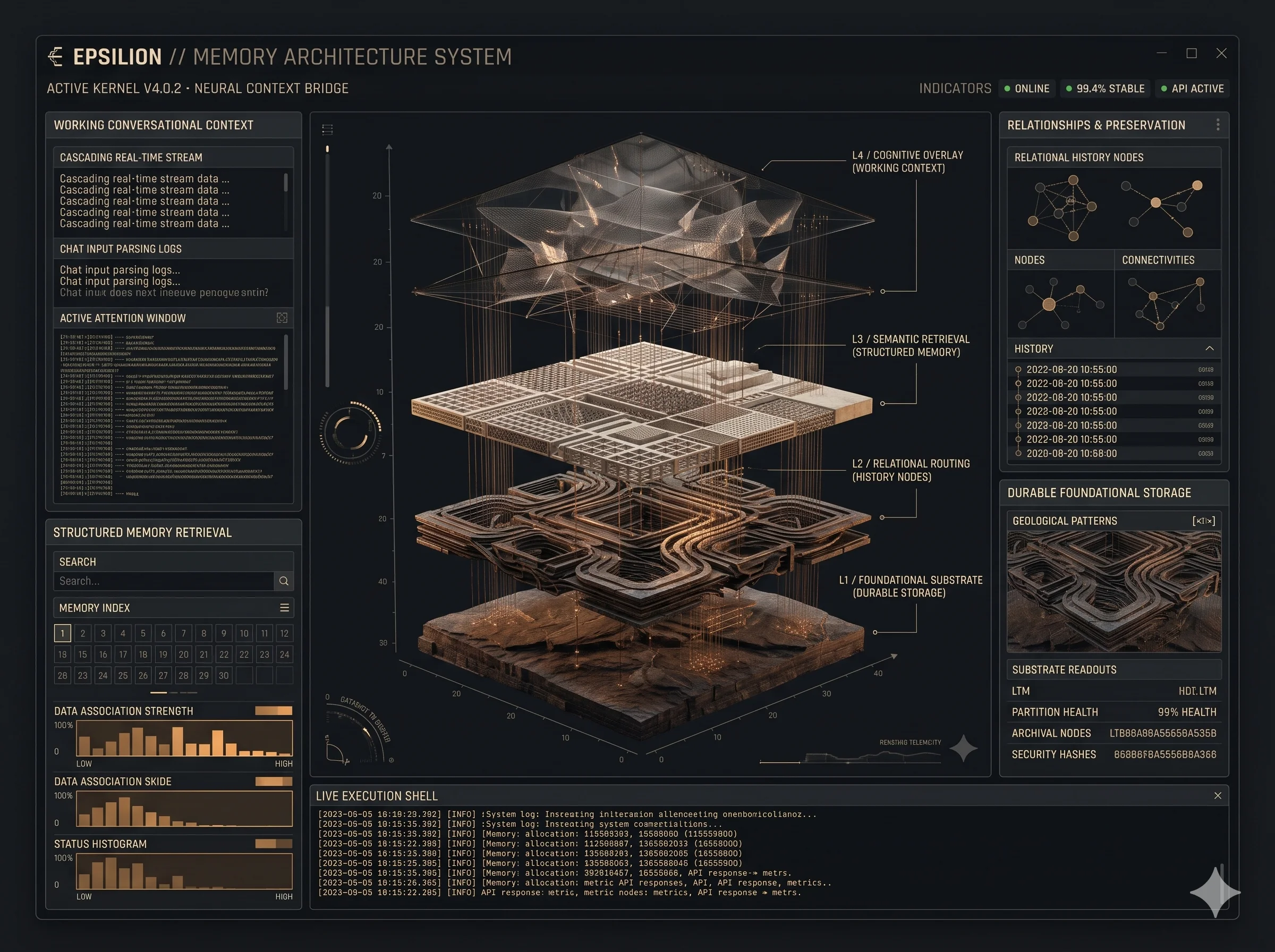
The Memory Bottleneck
Contemporary autonomous software agents face a fundamental state management deficit. Language models operate statelessly over finite sliding context windows. When context fills up, typical frameworks resort to blunt truncation or naive retrieval-augmented generation (RAG) that dumps unstructured text chunks back into prompt space.
This produces cognitive drift: agents forget earlier constraints, duplicate completed subtasks, and lack temporal causality. Project EPSILION approaches agent memory through the lens of classical computer systems architecture—treating memory not as an undifferentiated bag of text chunks, but as a structured, hierarchical storage pyramid.
The Three Memory Strata
EPSILION formalizes agent state across three coordinated tiers with distinct latency, mutability, and lifetime characteristics:
- Working Strata (Volatile): Analogous to CPU registers and L1 cache. Holds immediate turn context, active scratchpad notes, and currently evaluated tool outputs. Highly volatile and pruned aggressively as turn subgoals complete.
- Episodic Strata (Temporal Ledger): An append-only chronological ledger of agent actions, environmental responses, and causal chains. Records not just what happened, but why a particular decision branch was taken, enabling back-tracking and loop detection.
- Semantic Strata (Durable Knowledge): A persistent, verified entity and concept graph. Stores established truths, user preferences, codebase invariants, and system facts that remain valid across independent sessions and model changes.
Memory Consolidation Algorithms
The central challenge in tiered memory is the transfer mechanism between layers:
- Working to Episodic: Subtask completion triggers an automated crystallization event, converting ephemeral tool traces into structured episodic milestones.
- Episodic to Semantic: An offline background daemon periodically traverses episodic ledgers, identifying recurring entity relationships and promoting verified observations into durable semantic graph triples.
- Decay & Eviction: Low-relevance episodic details decay over time according to a power-law retention curve, preventing unbounded database growth while preserving critical inflection points.
Technical Specifications
| Research Stage | Conceptual Architecture & Data Schema Design |
|---|---|
| Storage Primitives | Relational Ephemerals + Directed Property Graph |
| Retrieval Indexing | Hybrid Lexical (BM25) + Structured Relational Filtering |
| Target Runtime | Local-first, daemon-mediated agent frameworks |
| Documentation | Architectural Whitepaper & System RFCs |